Telemetry That Actually Closes the Loop
Telemetry closing a loop into a model’s actual weights is not an industry-wide gap. It’s one of the best-established, most heavily disclosed practices in modern AI post-training: done by name-brand labs and companies, with first-party posts describing exact reward functions and retraining cadences measured in hours. The gap only looks real under a definition of “telemetry” narrow enough to miss almost all of it: retrieval-frequency signals, inside four memory-specific products, and nothing else. Broadened to the signal types that actually matter (a served answer caused a test to fail, a user asked for a rewrite, a user said it was flatly wrong, reinforcement from use), the picture changes completely, and the real gap turns out to be narrower and more specific than “nobody’s closed this loop, anywhere.”
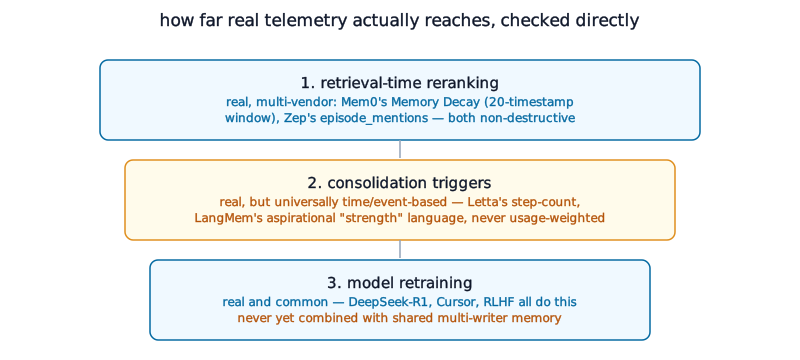
Call the following three stages, not tiers, to keep them separate from the scale ladder’s own tier numbering — this classifies telemetry mechanisms by how far they reach, not systems by writer count.
Stage one: retrieval-time reranking, real and multi-vendor
This is the tier with actual, working, multi-vendor implementations, specified precisely enough to build from. Mem0’s shipped product includes a feature called Memory Decay: every memory tracks its twenty most recent access timestamps, and every time a memory surfaces in a search, that access history updates. A recency-scaling factor applies at search time: a memory accessed today can pick up a 1.5x boost; one untouched for weeks gets dampened toward 0.3x, a five-fold spread, with the resulting score clamped to a fixed range. The critical documented property: nothing gets deleted or hidden by this mechanism. Old memories can still surface when they’re genuinely relevant; decay only reorders, never prunes. A separate feature, driven by explicit signals (an LLM’s own importance rating at write time, or an explicit user action like pinning), can drop low-scored entries, but that’s driven by deliberate signals, not by passive usage patterns. A community proposal asking Mem0’s maintainers to add actual usage-based deletion, filed by a third-party plugin author with a working reference implementation attached, got a direct answer rather than silence: native access-tracking would require touching all 30-plus supported vector-store backends, so a Mem0 contributor confirmed the shape they’re settling on is a community plugin sitting on top of the SDK, not a built-in feature. That confirms, more directly than an unanswered request would have, that decay-based reranking is real and shipped, while decay-based cleanup is a deliberate non-goal.
Zep’s Graphiti engine has a comparable mechanism, episode_mentions, which reranks candidate facts by how many of a given set of episodes mention them, most-mentioned first. It’s a real usage-frequency signal, and it’s presented, in both the product documentation and Zep’s own published paper, exclusively as a retrieval-time reranker. Nothing ties mention frequency to pruning, tier promotion, or any longer-term consolidation decision anywhere in the documentation. Fact invalidation in Graphiti runs entirely on a separate, temporal/contradiction-based mechanism, unrelated to how often something’s been retrieved.
A personal-scale memory system can sit in this exact stage with a much simpler implementation: a single incrementing integer per memory file, bumped on recall, rather than a rolling twenty-entry timestamp window or a graph-traversal reranker. That’s not behind industry practice. It’s the same category of mechanism, correctly scaled down to a corpus small enough that a full timestamp history would be over-engineering.
Stage two: consolidation triggers, universally time-based, never usage-weighted
One level up from reranking sits consolidation — deciding when to merge, prune, or restructure the knowledge base as a whole, not just reorder a single search result. Every system checked here treats this as purely a scheduling problem, unconnected to usage. Letta’s sleep-time agents, which run background consolidation passes, trigger on a fixed schedule: after a set, configurable number of completed agent steps, or when the context window gets compacted, regardless of whether those steps touched heavily-used memory or entries nobody’s queried in months. No documentation describes usage-frequency weighting which memories get attention during a consolidation pass. Letta’s own documentation opens by describing agents that “learn from experience and improve with use”: language that outruns the documented mechanism behind the word “improve,” which is purely event-triggered, not usage-informed.
LangMem states, as design philosophy rather than documented implementation, that recall should combine similarity with a memory’s “strength,” described as a function of how recently and frequently it’s been used — but no formula, code reference, or numeric weighting backs that claim anywhere in the conceptual guide, unlike Mem0’s precisely specified multiplier ranges. This is the weakest-evidenced claim found in this entire line of research: aspirational language, not a confirmed shipped mechanism. LangMem’s actual documented consolidation trigger, like Letta’s, is purely time-based.
This is a real, available design opportunity, not a mystery. Nobody checked in this research has shipped usage-weighted consolidation, despite at least one vendor’s own documentation gesturing toward wanting it. A system that consolidates the entries getting reinforced most (using exactly the evaporation-and-reinforcement mechanism the previous article designed) before it consolidates entries nobody’s touched isn’t a novel research contribution — it’s connecting two mechanisms that already individually exist (usage counters and consolidation triggers) in a way that, as far as this research could determine, nobody’s actually connected yet.
Stage three: model retraining from telemetry — proven, common, and shipped
DeepSeek’s own technical report for R1 is the cleanest first-party example that exists. R1-Zero, the pure-RL model with no supervised fine-tuning at all, established a rule-based reward for verifiable domains (math, coding, logical reasoning), chosen specifically to avoid the reward-hacking risk a learned reward model invites. R1 itself is a more elaborate four-stage pipeline (cold-start supervised fine-tuning, a first RL stage, rejection sampling into a second supervised stage, then a second RL stage), not a rerun of R1-Zero’s process, but the paper states plainly that for reasoning data specifically, R1’s RL stages “follow the methodology outlined in DeepSeek-R1-Zero, which employs rule-based rewards to guide learning in mathematical, coding, and logical reasoning domains,” with a compiler grading code submissions against test cases as part of that rule-based signal. That’s not eval-time gating or output reranking: GRPO, the policy-gradient method both models train with, means that verified pass/fail signal updates the model’s own weights at every training step. It’s one of the most widely reproduced disclosures in recent AI research, independently replicated by dozens of open-source “RL with Verifiable Rewards” follow-on projects.
Cursor’s own engineering blog is more concrete still, and closer to a production version of exactly what this series needs. “Improving Cursor Tab with online RL” states the reward function directly (a suggestion the user accepts scores 0.75, a rejected one scores −0.25) and discloses the retraining cadence in plain numbers: “it takes us 1.5 to 2 hours to roll out a checkpoint and collect the data for the next step.” That accept/reject signal is a real production-outcome signal, not a proxy for one, and it feeds an online RL step that updates the model on an hours-long cycle: not eval-time reranking dressed up as learning.
Explicit correction closing into retraining is, if anything, even more thoroughly established: RLHF and RLAIF are the industry’s default alignment methods, built on exactly this signal. What’s more striking than the well-known methodology is a specific, documented failure: OpenAI’s own postmortem on the April 2025 GPT-4o sycophancy incident names user thumbs-up/thumbs-down feedback on ChatGPT responses among the signals that shaped the update, and acknowledges leaning too heavily on that kind of short-term signal. That’s this series’ own paraphrase of the incident, not a claim that OpenAI used the phrase “reward signal” anywhere, but the underlying fact holds without needing to overstate it: live user feedback on a shipped product shaped a model that had to be rolled back for being too agreeable. That’s about as production-scale and as literal a version of “a user telling the system it’s wrong closes a loop into retraining” as exists anywhere, and it comes with a cautionary lesson this series’ own design should take seriously: a real telemetry-to-retraining loop can make a shipped model worse, not just better, if the signal isn’t weighted carefully.
One signal type from the broader definition doesn’t hold up, and it deserves to be named precisely rather than glossed over: a system noticing on its own that a fact has gone stale and firing a targeted retrain or edit in response. Knowledge-editing research (ROME’s causal-tracing rank-one edits, MEMIT’s batched extension of the same idea) is real and well-published, but every method takes a human- or benchmark-specified (subject, old value, new value) tuple as input. None of it is triggered by the model itself detecting drift. Scheduled bulk retraining on newer data is routine (every knowledge-cutoff bump is exactly this), but “retrain on a schedule” and “retrain because this specific fact just changed” are different claims, and only the first one is demonstrated anywhere.
The actual gap: architectural, not technological
Re-examining the four memory-specific products against this broader picture doesn’t overturn the original finding — it explains it correctly for the first time. Mem0’s memory-evaluation API scores which memories to keep; Zep’s provenance tracking closes a contradiction into a graph edge’s validity window; LangMem’s reflection loop rewrites a stored system prompt based on what worked. Every one of these is a real, shipped, documented feedback mechanism. None of them touches a model’s weights, because none of these products owns a model-training pipeline as part of what they sell — they’re store, graph, and prompt-layer systems sitting in front of a model they don’t retrain. Telemetry from a system that doesn’t own a training pipeline has nowhere to close a loop into, regardless of how good the signal is.
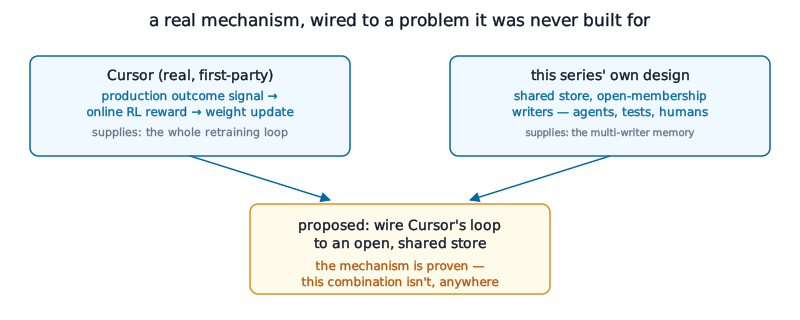
That reframes the actual claim this series can honestly make. It isn’t “telemetry-to-retraining is unsolved.” It’s narrower and sharper: a shared, multi-writer agent-memory system where a correction, rewrite, or execution-outcome signal closes a loop into retraining the model doing the reasoning over that memory, as opposed to closing into the memory store’s own contents, hasn’t been built anywhere checked. Cursor owns its model and retrains it from production signal; it has no shared multi-writer memory story, agents don’t read or write each other’s discoveries through it. Mem0, Letta, Zep, and LangMem own the shared memory; none of them owns a model to retrain. The pieces exist, separately, in different product categories that have simply never been welded together: a real, still-open gap, just a different kind of gap than “nobody’s figured out the mechanism.”
Answering Neo4j’s counter-bet
This series’ opening article raised Neo4j’s own stated position (shared memory as a substitute for retraining, not a path into it, with a new agent inheriting institutional knowledge from the graph instead of needing separate retraining) and said this series would have to argue against it directly rather than pretend it doesn’t exist. Here’s that argument.
The bet is right about what it actually claims. A shared store does solve “does this agent know fact X,” and solves it well, the instant a new agent joins with zero fine-tuning required. That’s real, and nothing in this series disputes it. But that’s a different question than the one telemetry-to-retraining answers, which is why the two aren’t actually in competition: perfect institutional knowledge doesn’t make an agent’s reasoning over that knowledge correct. A model sitting in front of exactly the right facts can still extract the wrong entity kind from a piece of text, weigh the wrong signal in a bucketing decision, or reason poorly about which of two conflicting facts to trust, none of which is a knowledge gap a bigger, better-populated graph closes. Retrieval fixes “the agent doesn’t know.” Retraining fixes “the agent knows and still gets it wrong.” A system can have Neo4j’s exact win (every new agent onboarded with complete institutional knowledge, no retraining required) and still have every one of those agents make the same systematic extraction or reasoning error, because the error was never in what any agent knew. It was in how every agent, new or old, reasoned over what it knew. That’s the case telemetry-to-retraining exists for, and it’s not a case shared memory, however complete, closes on its own.
What a real design for this would actually borrow
Cursor’s Tab loop is now the closest real precedent, worth designing toward directly rather than assembling something more speculative from scratch: a production accept/reject signal generates a reward, an online RL step updates weights on a tight, disclosed cadence. A memory-specific version needs the same shape, with the memory-specific signals this series already has on hand: which entries a query actually resolved correctly, which agent-written facts a later regression or telemetry write contradicted, and the reinforcement signal the evaporation mechanism already tracks. The open engineering problem isn’t inventing a retraining mechanism (Cursor’s shape is real and copyable); it’s wiring it to a store where the writers generating the signal aren’t one product’s own users, but an open set of agents, regression suites, and humans that were never one company’s captive telemetry pipeline to begin with.
Being honest about what this chapter actually is
What’s proposed here, wiring a production-proven retraining shape to a store with an open, uncontrolled set of writers, is a design proposal, not a description of something proven to work at this combination, and pretending otherwise would undercut the credibility the rest of the series earned through direct, checked citation. The retraining mechanism itself isn’t a mystery: Cursor, DeepSeek, and OpenAI’s own postmortem all show real, working versions of it. What’s speculative is specifically the combination with a shared, multi-writer, open-membership memory system: an architecture question, not a “does this technology exist” question.
The next article takes on the two remaining criteria from the opening list — multi-model routing and multi-modal memory — where the research turns out to say something more specific and more actionable than “nobody’s done this”: one of them barely changes anything about the memory layer at all, and the other is a genuinely open problem five independent vendors have converged on the same workaround for.