The Search for a Counterexample
The conversation that started this series began with a friend describing, in broad strokes, what the future of AI infrastructure should look like: your own trained models, several of them, routed by task; memory that spans more than text; and a database every agent and every automated system writes to and reads from, all at once, that gets smarter as it’s used. It sounded like a reasonable extrapolation of where things are obviously headed. The instinct, before writing a single line of architecture, was to check whether “obviously headed there” meant “already arrived” somewhere out of sight.
It doesn’t. This article is that check, done as rigorously as a blog post can manage: not a survey of AI trends, but an adversarial search for a counterexample, actively trying to prove the premise wrong before building anything on top of it.
The four criteria
Strip the friend’s description down to testable claims and you get four:
- (a) Concurrent multi-agent shared knowledge base. Many independent writers: not one agent with a memory file, but many agents (and, as later articles in this series argue, many non-agent systems too) reading and writing the same store at the same time.
- (b) A real telemetry-to-retraining loop. Usage data doesn’t just rerank what gets retrieved next time. It closes a loop into the model’s actual parameters. Not a prompt adjustment, not a cached summary. Weights that are different because of what happened in production.
- (c) Multi-modal memory. Not memory that stores images by captioning them into text and discarding the pixels. Actual non-text content, retained and reasoned over as itself.
- (d) Multi-model routing that’s aware of the memory layer. Different models get used for different tasks, and that routing decision is coupled to the same shared knowledge base, not just a separate load-balancer sitting in front of it.
Any one of these is well-trodden ground in isolation. Distributed databases have handled concurrent writers for decades. Federated learning closes telemetry loops into weights, just not for agent memory specifically. Multi-modal embeddings are a mature research area. Model routers are a commodity engineering pattern. The claim under test was never “has anyone built a system with concurrent writes” — obviously yes. It was: has anyone combined all four, specifically for AI-agent knowledge infrastructure. That’s a much narrower, much more falsifiable question, and it’s the one worth checking before writing seven more articles that presuppose the answer.
What “close” looks like
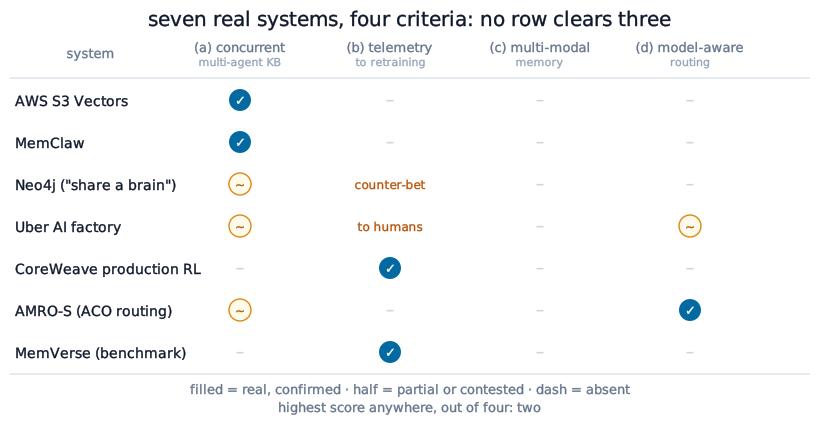
The search covered academic literature on arXiv, first-party enterprise engineering blogs, vector and graph database vendor case studies, and MLOps platforms applied to agent telemetry — about thirty primary sources fetched and read directly, not taken from a search snippet. Every system found was scored against the four criteria using only what its own source directly states, not marketing framing. The result, compressed into one sentence: no system cleared three of the four criteria, let alone all four, and which two criteria keep showing up together — never three — is itself the finding.
Systems with real concurrent multi-agent memory (a) are, without exception, pure retrieval systems. MemClaw, described in “Governed Shared Memory for Multi-Agent LLM Systems” as a production “fleet” memory service, is the strongest academic match: it identifies real failure modes in multi-agent shared memory (stale propagation, contradiction persistence, provenance collapse) and fixes them with scoped retrieval and policy-governed propagation. It contains zero mention of weight updates, zero mention of non-text modalities, zero mention of model routing. AWS’s own Storage Blog describes a concurrent multi-agent pattern built on S3 Vectors (agents recording findings, other agents checking what’s already been tried) with real code, not just a diagram. It runs a single text embedding model throughout. The closest thing it has to a telemetry signal is a confidence field on stored facts that decays over time: explicitly metadata decay, not a weight update. Same shape, same gap.
Systems with a real telemetry-to-retraining loop (b) are, without exception, single-agent or single-pipeline, with no shared-memory story at all. CoreWeave’s own engineering blog describes serverless reinforcement learning wired to production inference, turning “high-quality production data into signals that autonomously improve agent reliability over time”: a closed loop from usage into model improvement, described in first-party detail. There is no shared multi-agent knowledge base anywhere in that post; the loop runs per-agent, production to training, not agents reading and writing each other’s discoveries.
The one real hit on stigmergy and pheromone-based coordination applied to LLM agents (the mechanism this series eventually leans on for automatic invalidation) is AMRO-S, “Efficient and Interpretable Multi-Agent LLM Routing via Ant Colony Optimization.” It routes queries across a pool of language models using literal ant-colony pheromone specialists, with “quality-gated asynchronous updates decoupling inference from learning” and reported speedups with maintained accuracy. The pheromone matrix is the shared memory the routing decision reads and writes: real criterion (d). But the pheromone updates are updates to a routing table, not to any model’s parameters, so it doesn’t clear (b) in the sense that matters here. No online loop runs from production telemetry into weights, just a one-time offline fine-tune for the router itself, and no multi-modality appears anywhere in it.
One paper deserves a closer look than a quick citation, because the first read of it looked like the strongest multi-criterion match in this entire search, and closer reading corrected that: a paper called MemVerse, which frames itself as “transforming raw multimodal experiences into structured long-term memories organized as hierarchical knowledge graphs” and is equipped with “a periodic distillation mechanism that compresses essential knowledge from long-term memory into the parametric model, allowing fast, differentiable recall.” That’s a genuine memory-to-weights pathway, not retrieval reranking dressed up as learning, and it’s the strongest single (b) match found in the academic literature. But the “multimodal” framing doesn’t hold up against this series’ own bar for criterion (c): the paper’s own methodology section describes converting images, audio, and video into text captions before anything gets stored: “images are captioned using GPT-4o-mini; audio is transcribed via Whisper,” the identical caption-and-discard pattern this series later finds industry-wide in article 7, not the “retained and reasoned over as itself” this series requires for a real (c) claim. MemVerse clears (b) alone, not (b)+(c). It is also explicitly framed as “model-agnostic, plug-and-play” for a single agent, with zero multi-agent concurrency story, and it’s a benchmark paper — “extensive experiments demonstrate” — not a described production system.
The one deliberate counter-bet
Not every vendor is simply silent on this. Neo4j’s own product blog, in a piece literally titled “When Your Agents Share a Brain,” describes real concurrent multi-agent access: “every agent in the system reads and writes to three memory layers, all stored as nodes and relationships in Neo4j.” It then frames the entire payoff as the opposite of a telemetry-to-retraining loop: a new agent can join the system and inherit institutional knowledge without needing to be separately retrained or prompted into that knowledge, because the shared graph does the work retraining would otherwise have to do. That’s not a gap Neo4j failed to close. It’s a stated architectural position: shared memory as a substitute for retraining, not a path into it. This deserves to be taken seriously rather than dismissed. It’s a reasoned bet from people who build graph databases for a living, and this series has to argue against it directly rather than pretend it doesn’t exist.
The closest real system, and why it still falls short
The most architecturally complete real-world system found in this entire search isn’t a research paper or a vendor pitch. It’s Uber’s internal AI coding platform. Early reporting on it came secondhand, via Gergely Orosz’s Pragmatic Engineer newsletter and a companion piece from Port; Uber has since published its own account directly (“Running a Software Factory Efficiently at Uber Scale,” Uber’s own engineering blog), which gives the authoritative numbers: a context graph of 24 million nodes and 80 million edges across 86 node types and 117 edge types, connecting mobile app structure, backend services, and the data lake, at real production scale, with agents reading from it continuously. Uber also runs a model gateway proxying requests to Claude Code, GitHub Copilot, and Codex: real multi-model routing in production. On paper that’s (a)-read plus (d), two of four, from a company operating at a scale most of this series will only gesture at.
But the reporting is specific enough to be honest about where it stops. Uber “collect[s] usage traces and run[s] continuous evals, then feed[s] the results back” — and that loop closes into skill engineers, humans who refine agent prompts and skills, not into model weights. The multi-model routing is a gateway, not a system that reads the context graph to decide which model handles a given query. The two pieces sit next to each other rather than being coupled. No modality beyond text and code appears anywhere in either source. This is the strongest real system found, built by people with essentially unlimited engineering resources relative to a single-author blog series, and it still falls two full criteria short, with its own authors’ framing making the human-in-the-loop nature of the telemetry path explicit rather than accidental.
What this actually means
None of this is an argument that the individual pieces are hard to imagine. Every piece has been built by someone, somewhere, usually well. What doesn’t exist is the combination: not in a shipped product, not in a disclosed internal system, not even in a benchmark paper reaching for two criteria at once. The four things don’t compose in anyone’s public architecture, and the near-misses are close enough, and specific enough, that this isn’t a case of nobody having tried. MemClaw’s authors clearly thought hard about concurrent multi-agent memory and didn’t reach for retraining. CoreWeave’s engineers clearly closed a real telemetry loop and didn’t reach for shared multi-agent state. Neo4j’s team looked at exactly this intersection and explicitly bet against one arm of it. This is a genuine, current gap, not an oversight waiting to be filled by the next press release.
That’s the premise the rest of this series is built on, and it’s a narrower claim than it might sound. It is not a claim that this is easy, or that a solo-authored series will solve distributed systems problems large infrastructure teams haven’t. It’s a claim that the design space is open enough to map carefully, in public, starting from something small and real rather than something large and speculative. The next article does exactly that, not by jumping straight to hundreds of thousands of concurrent writers, but by building a scale ladder, because the failure modes at two writers, twenty, and two hundred thousand are different problems wearing the same name. Conflating them is the fastest way to design something simultaneously over-engineered for what you have and inadequate for what you’re planning toward.
One honest caveat, stated plainly rather than buried: this search had real limits. No ACM or IEEE digital library subscription was available, so the academic search leaned on arXiv, which skews toward certain subfields and misses venues that gate their proceedings. Conference talks (the StrangeLoop and QCon sessions that sometimes disclose more than blog posts do) turned up session listings, not transcripts, so that category is genuinely unresolved rather than confirmed empty. Treat the verdict as strong evidence, checked as hard as a public search allows, not as mathematical proof. That distinction matters more here than it would for a lower-stakes claim, precisely because the rest of this series leans on it.
Update, 2026-10-03: Claude Code’s own Agent Teams feature, Anthropic’s newest multi-agent product, shipped with filed, confirmed concurrency bugs of exactly the shape this article catalogues elsewhere: a role-blind self-claim bug that let a read-only reviewer claim 14 implementation tasks before manual reassignment (#93668), and a “replay storm” where a surviving writer gets already-completed task assignments replayed to it (#68336). That’s the lab with the most resources and the most motivation to have solved concurrent multi-agent memory, hitting the same unsolved problem MemClaw’s and Letta’s own authors already faced. LangGraph’s default on an unannotated concurrent write is still to error outright rather than merge silently, and OpenAI’s Agents SDK still ships shared sessions with no concurrency guarantee beyond whatever the backing store gives for free. Nothing found since clears more than two of the four criteria. The premise holds.
Update, 2026-10-05: a second pass on criterion (a)’s reinforcement mechanism, prompted by how crowded “Hebbian reinforcement for agent memory” got this year. HeLa-Mem, A-MEM, and three smaller open-source projects (synaptic-memory, brain, mnemoria) all now ship some form of access-pattern-driven or explicitly Hebbian reinforcement for LLM-agent memory. Checked the same way as everything else in this article, against what each one’s own source does rather than its pitch: none bounds the reinforcement signal (no floor like MAX-MIN Ant System’s, so nothing stops an early winner from entrenching permanently), and none logs the candidate set a reinforcement decision was chosen from, so none can later correct for its own retrieval bias — an entry that was rarely surfaced looks identical to one surfaced often and rejected. Both gaps are exactly what this series’ pheromone-invalidation article builds in from the start rather than leaves as future work. Reinforcement for agent memory, as a category, cleared criterion (a) in several places this year. Bounded, logged reinforcement did not turn up anywhere in this second pass.